Anna's first call
Anna runs a small autumn fair on a village green outside Dorchester, and she rang us in the weeks before the event with a plain question: could the main stage be shown on a screen in the marquee and online for relatives who could not attend? She had never worked with a gallery crew and was not sure what to ask for.
I took the call, as I do for most new enquiries. We talked through the running order, the number of acts, the size of the stage and where people would stand. I asked what she wanted viewers to see at each moment, because that decides how many cameras are needed and what the technical director should be watching for.
She wanted the choir, the brass band and the children's dance group to look as good as the headline act. That told us the cutting had to be even-handed, with no camera left on a wide shot out of habit.
Planning three cameras for a small stage
We settled on three cameras: a wide shot from the back of the green, a second operator at the side for close work on faces and hands, and a third low at the front for the dancers. Helen Marsh, our technical director, walked the site beforehand and marked where cables could run without crossing the audience path.
A short stage does not need many cameras, but it does need each one to have a clear job. Helen wrote these into a simple camera sheet, so every operator knew what to hold and when to change shot size. The sheet is one page, and it travels with the run sheet.
We also agreed who would give the calls. Anna's friend Jon would direct from the side of the stage, and Helen would switch on his word, so that the voice in everyone's headset was always the same.
- One wide camera for safety and context
- One side camera for close shots
- One low camera for movement and dance
- A single caller on the intercom
What switching actually means on the day
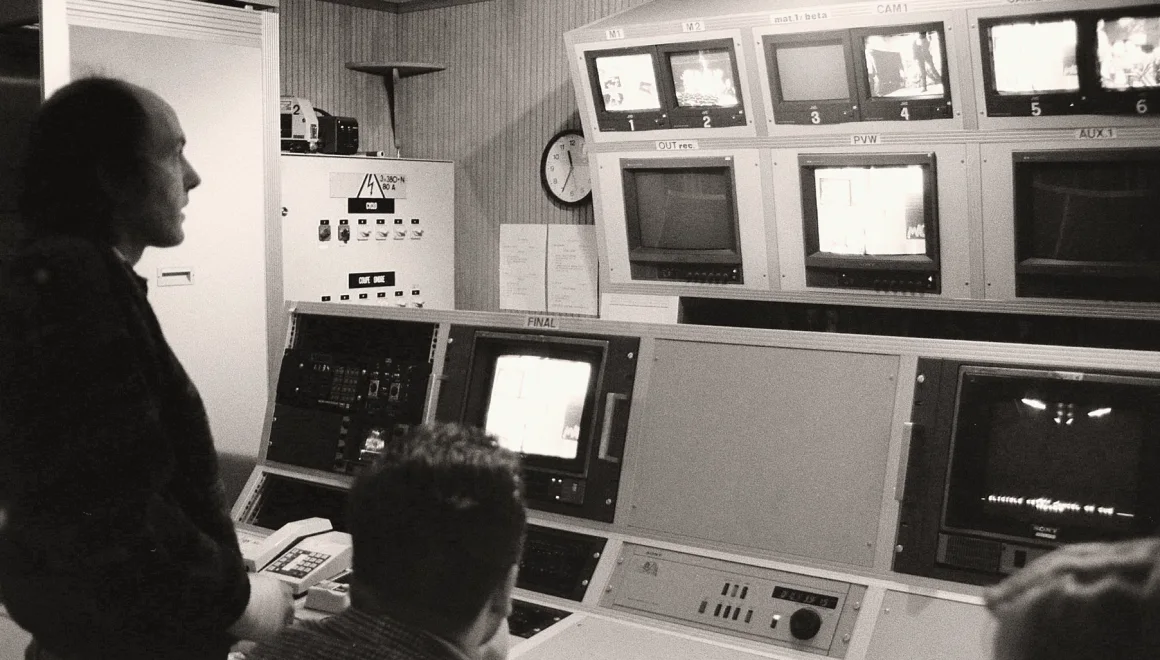
Multi-camera switching is the live choosing of which feed viewers see. Helen sat at a compact vision mixer with all three cameras on small monitors in front of her, a script beside her and the intercom open. When Jon said ready camera two, take two, she had already lined the shot up and was waiting for his word.
The skill is mostly anticipation. A choir changes position as the conductor lifts a hand; a dancer turns before the music does. Helen watched for those small signals so the cut landed on a good frame rather than a late one.
Nothing about this is dramatic from the outside. If it goes well, the audience simply watches the performance and forgets that anyone is choosing for them, which is the result Anna had hoped for.
The moment the plan changed
Halfway through the afternoon the brass band moved from the stage to the front of the green to play among the crowd. It was not on the running order, and nobody had told the gallery. The low camera operator saw it first and called it on the intercom before the band had finished walking.
Because the wide camera was already set to cover the green, Helen could cut to it straight away and let the picture show what was really happening. Jon adjusted his calls to fit, and the side camera was sent round to catch the players at close range.
This is why we prefer short, clear intercom talk and a technical director who is not tied to the paper. The script is a guide, and a good crew keeps the broadcast honest to what is in front of the lenses.
What Anna said afterwards
When the last act finished, Anna came into the marquee to look at the screen replay and said she had expected something stiffer. She had watched the online feed on her phone between tasks and thought it looked like the day felt: busy, warm and a bit crooked in the best way.
She also told me what she would change. She wanted the announcements made on stage to be shown with a name caption, which our graphics operator, Tom Whitcombe, can add next year without extra cameras. We noted it and moved on to packing up.
The kit was off the green within the agreed time and the cable routes were walked once more to check nothing had been left behind. A calm finish matters as much as a calm start.
What this case shows about switching
A small event does not need a large crew, but it does need a clear plan, a single caller and a technical director who understands the people on stage. Anna's fair worked because the camera jobs were defined before the day and the team was able to adapt when the band walked off.
If you are thinking about live switching for a local event, the useful preparation is simple: send us the running order, tell us who will direct, and say what you want viewers to see from each act. We can build the camera plan from there and tell you honestly if you need fewer cameras than you expected.
That conversation costs nothing and often saves a surprise on the day.
Anna's fair was a modest job, but it carried the same lesson as our larger shows: good switching starts with a clear plan and a calm voice on the intercom. If you have a local event in mind, send us your running order through the contact page and Priya will talk it through with you, one step at a time.