The question we hear most often
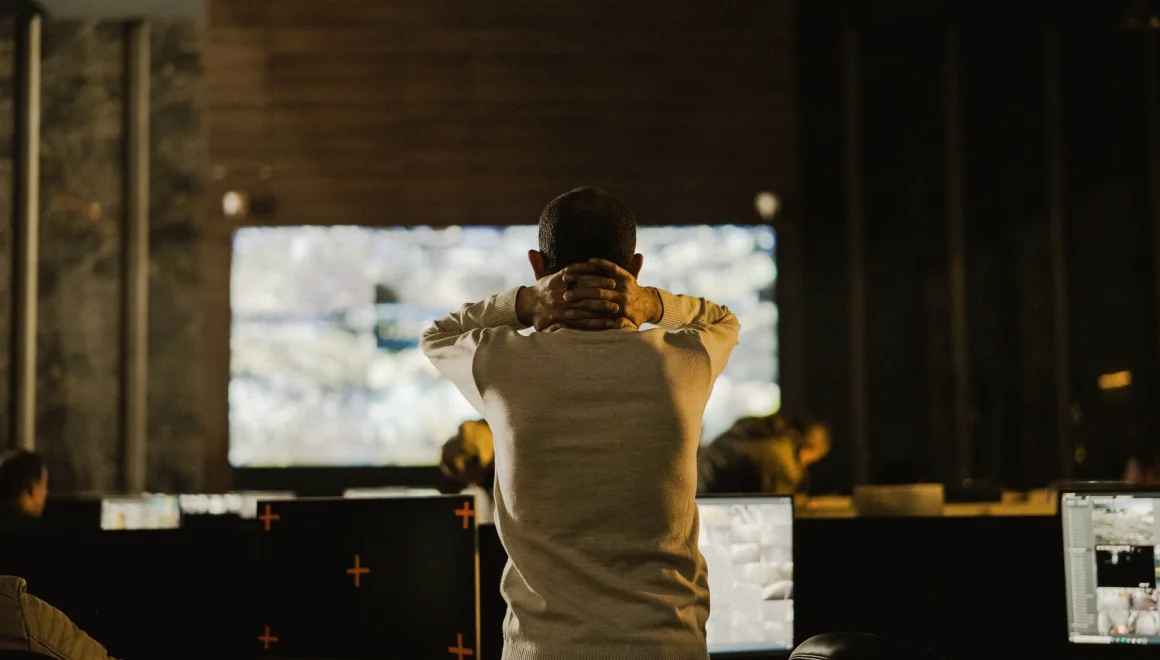
Almost every new enquiry includes some version of the same question: what is the person at the switching desk actually doing? From the outside it looks like someone pressing buttons while watching a wall of small screens. Organisers imagine either something very simple or something impossibly technical, and neither picture helps them plan their event.
The honest answer is that multi-camera vision switching is a job of listening and timing. The technical director takes the feeds from every camera, follows the show script, and puts the right picture on the programme output at the right moment. I have done this for television and streaming for over fifteen years, and the work has never been about speed on the buttons. It is about knowing what is coming next.
This article answers the question in plain terms, so that if you are booking a crew for a concert, a stage event or a streamed conference, you know what we are doing and what we need from you.
Following the script and the director's calls
Before doors open, we receive a running order or script. It lists the acts, the speeches, the songs or the segments, and where each camera is expected to be. In the gallery I mark it up so that every shot has a number and a purpose. During the show, the director talks to the camera operators over intercom and calls the shots: ready camera two, take two, ready camera four on the drummer.
My job is to carry out those calls precisely. When the director says take two, camera two goes to air at that instant, not a second later. The director is thinking about the story of the show; I am thinking about the execution, and about whether the next feed is clean and correctly framed.
When there is no director in the room, the technical director often does both jobs, which is why the script matters so much. A clear running order lets us make good decisions without stopping the show to ask.
- A numbered script with cues is the most useful document you can send us
- Directors call shots; the technical director takes them on the desk
- Intercom is open to every camera operator throughout
What is on the desk and the monitor wall
The vision mixer, sometimes called the switcher, has a row of buttons for each input and a larger bus for the programme output. Above it is a monitor wall showing every camera, the preview of the next shot, and the live output. I am usually looking at the preview, not the programme, because the programme is already happening and the next move is what needs my attention.
Besides straight cuts, the desk handles dissolves, wipes and the layering of graphics. A slow dissolve suits a ballad; a hard cut suits a drum fill. These are small judgements, but they shape how the show feels to the viewer at home or on the venue screens.
We also keep an eye on technical health: signal loss, a camera drifting out of focus, an audio feed that has gone quiet. Catching these early is part of the calm that clients tell us they notice.
Why timing matters more than speed
A common assumption is that the best switcher is the fastest. In practice, a rushed cut is usually a bad cut. The skill is anticipation: watching the singer step towards the front, hearing the key change, and having the right camera ready a beat before the moment arrives.
This is why we like a rehearsal or at least a soundcheck. Hearing the band, seeing the stage lit, and learning where each operator will stand lets me build a mental map of the show. Without it, I am reacting; with it, I am leading the picture.
Mistakes do happen on live television, and the way to handle them is to stay steady. If a camera is not ready, we take another and move on. Viewers rarely notice a recovered moment, but they always notice a panicked one.
- Rehearsal time turns reaction into anticipation
- A recovered shot is invisible; a flustered gallery is not
What we need from you before the day
The more we know early, the calmer the show runs. Send us the running order, the venue layout, the number of cameras you expect and whether the output goes to screens, a recording or a live stream. If there is a house director or an artist's own visual team, tell us so we can agree who calls the shots.
Access matters too. We need time to rig the desk, run cables and test the intercom before an audience arrives. A gallery squeezed in ten minutes before the doors open is a gallery that is working at a disadvantage.
Priya Nair, our production manager, is the first contact for new enquiries and will ask these questions anyway. Having answers ready speeds up the quotation and lets us plan crew and kit properly.
- Running order or script with cues
- Venue plan and camera positions
- Where the output is going: screens, recording or stream
- Who is directing and who calls the shots
What a good result looks like
When vision switching is done well, you do not notice it. The picture follows the performance, the cuts feel natural, and nobody in the audience or at home thinks about the gallery. That is the aim: the technology disappears and the show comes through.
If you have watched a live event and felt that the pictures simply made sense, a technical director was probably doing quiet, careful work behind the scenes. If you are planning your own event, that is the standard to ask any crew to meet.
We are always glad to talk through a plan before you commit to anything, and to explain in more detail how a particular show would be covered.
A technical director cuts between camera feeds live, following the script and the director's calls, with timing and calm doing most of the work. If you are planning a concert, festival stage or streamed event, send us your running order and a rough venue plan through the contact page, and we will tell you plainly how we would cover it.